
Every January, a few days before the AP Most Valuable Player ballot closes, I get the same call from at least one client. “Why did I just lose a £200 stake on a player who threw for 4,500 yards?” My answer hasn’t changed in nine years of pricing this market: because he played for a 9-7 team, and the MVP is not a stats award. It is a narrative award decided by 50 people who have a checklist, whether they admit it or not.
Quarterbacks have won the MVP in 13 consecutive seasons. The last non-QB to lift it was Adrian Peterson in 2012. Over the last 26 seasons, quarterbacks have collected 23 of the 26 awards. That is not a coincidence, a fashion, or a fluke. It is a structural feature of how the panel votes — and once you internalise it, the entire MVP futures board starts to read like a Premier League title race rather than a stats sheet.
This guide is for UK punters who want to bet the MVP market sensibly. We will cover the difference between the regular-season AP MVP and the Super Bowl MVP — they price entirely differently, and confusing them costs money. We will dig into the QB stranglehold and the 11-win team rule. We will look at how the 50 voters actually think. And we will finish with the staking and hedging strategy I use when I do back a longshot — because once a year, I do, and the worked examples below will tell you when it makes sense.
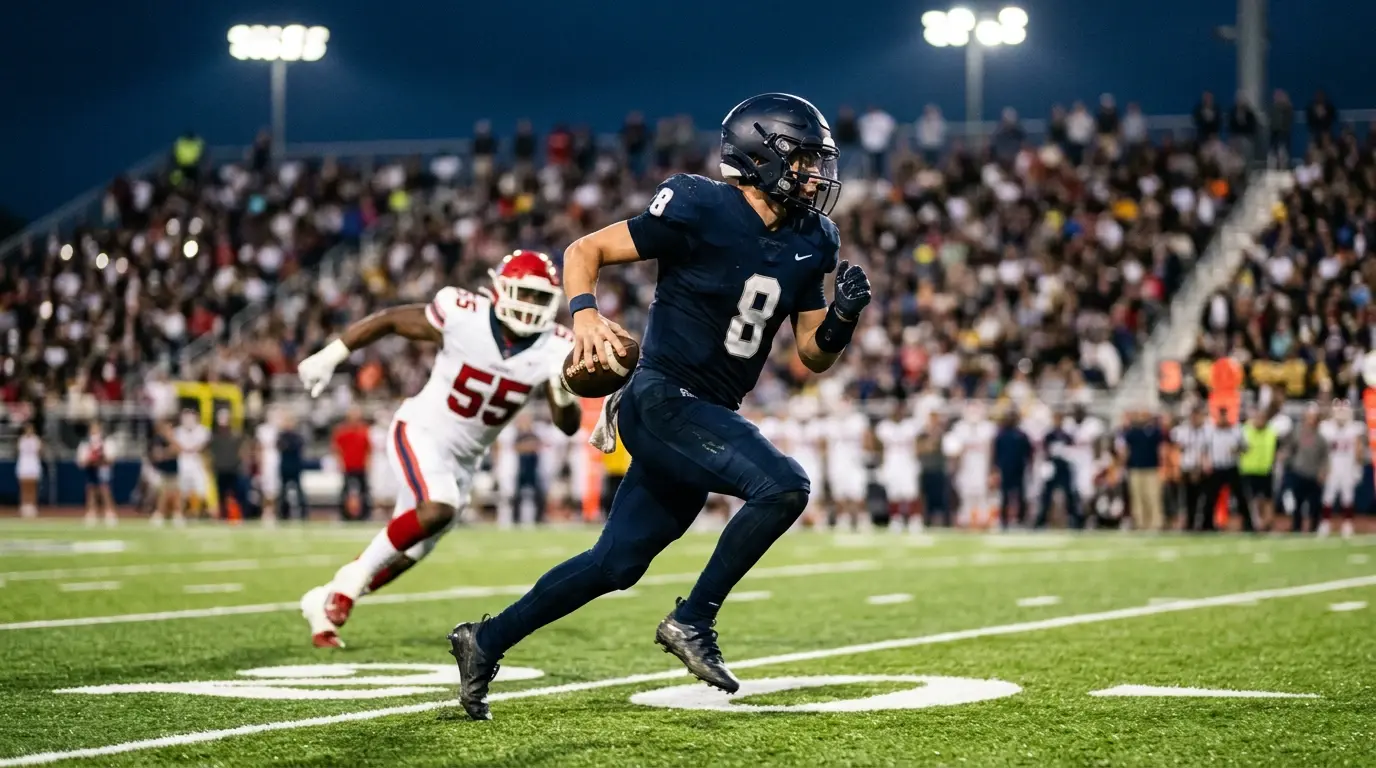
Modern voters heavily favor dual-threat signal-callers, making quarterback rushing stats a vital metric when assessing the award board.
Two MVP awards, two completely different markets
I had a punter walk into a UK retail shop in February 2022, slip in hand, asking why his MVP bet had not been settled when Cooper Kupp won the Super Bowl MVP. The slip read “Patrick Mahomes MVP — winner”. The shop manager had to explain, gently, that the regular-season MVP had been declared three days before the Super Bowl. The slip was a loser. The punter had been backing the wrong award for four months.
The NFL has two MVPs. The Associated Press Most Valuable Player is the regular-season award, voted on by 50 sportswriters and broadcasters, and announced at the NFL Honors ceremony the night before the Super Bowl. This is the futures market every UK book means when they list “NFL MVP”. The Super Bowl MVP is a separate award, voted on by media members at the final itself and a fan vote, decided within an hour of the game ending. UK bookmakers list it as a distinct market — usually “Super Bowl MVP” or “Big Game MVP” — and it does not pay out on the regular-season MVP slip.
The two markets behave nothing alike. The regular-season MVP is a four-month run-up to a near-certain quarterback win, with prices shortening or drifting based on weekly performances and team record. The Super Bowl MVP is a single-game prop priced almost entirely on the team most likely to win the game and the players on that team. A quarterback on the favourite is usually 6/4 to 2/1 on Super Bowl Sunday; the same quarterback might be 15/2 in the AP MVP market in December. They are different products.
For UK punters, the practical implication is that “MVP futures” on most sites and most books is the AP regular-season award. If you want to bet the Super Bowl MVP, you ask for that specific market, and it usually does not open until both Super Bowl participants are confirmed in late January. There is no overlap. A bet on one is not a bet on the other. Read the slip header before you place a stake. I have seen too many punters lose money because they did not.
One subtle point that matters for settlement. The AP MVP is settled on the AP award, not the PFWA or other writers’ organisations’ awards. Some leagues track the Sporting News MVP or PFWA Player of the Year. UK bookmakers settle on the AP award only — anything else is a separate market. If your bookmaker rules say “MVP”, that means AP. Check the rules tab on your bookmaker’s MVP page once before staking; the wording is sometimes buried.
Thirteen straight QB winners and what it does to the price board
Pull up any UK bookmaker’s MVP board in September. Count the quarterbacks in the top ten priced names. The answer will be nine or ten out of ten. That is not a sample-size accident. It is the bookmaker pricing for the only outcome that actually happens. Thirteen consecutive seasons of QB MVPs. Twenty-three of the last twenty-six. The probability of the next MVP being a quarterback is, by any honest empirical reading, somewhere between 88% and 92%.
Why is this? Three structural reasons. The first is that quarterbacks touch the ball on every offensive snap, which gives them statistical visibility no other position has. A running back gets the ball 15-22 times a game; a quarterback gets it 35-45 times. The second is that modern NFL offences are designed around the quarterback to a degree that did not exist in the 1990s. A quarterback playing well makes a team play well, which loops back into the team-record filter we cover in the next section. The third — and least discussed — is voter familiarity. The 50 AP voters watch every game with the broadcast camera locked on the quarterback. Their mental model of “most valuable” defaults to whoever the camera is following.
What this does to the price board is brutal. Every credible starting quarterback on a team with a winning record is in the top 15 names. That compresses the implied probability heavily into the top of the board. On a typical UK MVP market, the top three QBs alone often carry combined implied probability of 55-65%. The non-QB section of the board — running backs, wide receivers, defensive players, even the headline names — is priced down at 50/1 to 250/1, and the implied probability on most of those tickets is closer to 0.5% than to 2%.
I price the MVP market with what I call the 90/10 rule. I treat the probability of any quarterback winning as 90% in aggregate, and split the remaining 10% across non-QBs collectively. That means before I even look at a single name, I know that any non-QB ticket needs to imply less than 10% probability to be worth a glance — usually it needs to imply less than 5% to be worth a stake, because most non-QB names are not even credible MVP candidates.
Quarterbacks themselves break into three tiers. Tier one is the credible MVP candidate playing for a contender — usually two to four players in any given year. Tier two is the very good quarterback on a team with a question mark on its record. Tier three is the rest of the league. Tier one carries the bulk of the value when bookmakers misprice the MVP race; tier two is where over-priced public favourites live; tier three is, in most years, dead money. Your job at the start of the season is to identify which two or three names sit in tier one and decide whether the price reflects their actual chances.
The 11-win team filter that wipes out two-thirds of the field
If you remember one rule from this article, make it this one. In the last 13 NFL seasons, every single MVP winner has played for a team with at least 11 regular-season wins. Over the last 26 seasons, 25 of the 26 MVPs played for a team with 11 or more wins. The single exception is so rare it does not adjust the rule materially. This is the closest thing the MVP market has to a hard filter.
What this means in practice is that the moment a team falls to 5-4 or worse by mid-November, its quarterback is functionally eliminated from MVP contention, regardless of his individual numbers. Bookmakers know this. The price on a 3,500-yard, 30-touchdown QB on a 7-10 team is 100/1 not because the QB played badly, but because the team did. The voters do not vote for a losing record. The history is decisive.
Apply this filter at the start of every season. Look at the preseason MVP board. Identify the teams the consensus expects to win 11+ games. Cross-reference with the QBs on those teams. Anyone whose team is not projected for 11 wins should be off your shortlist unless you have a strong contrarian view on the team’s record. Most years that filter alone eliminates 22 of the 32 starting quarterbacks. You are left with 8 to 10 credible candidates. That is your working list.
The 11-win rule also creates a useful market structure for hedging. If a candidate’s team starts 6-1, the MVP price compresses fast — they are now on track for 14+ wins, and the voter narrative starts to lock in. If the same team falls to 6-4 by mid-November, the price drifts hard, and the candidate is functionally out unless they go on a long run. This makes mid-November the single best hedge window of the season for early backers. We will come back to this in the hedging section.
One nuance for 2026 onwards: the 17-game schedule means 11 wins represents a different effective record than it did in the 16-game era. A 10-7 team in the new format is roughly equivalent to a 10-6 team in the old format — close, but not quite to the historical 11-win threshold. So far, voters have continued to use 11 wins as their de facto benchmark; my expectation is that this drifts slightly toward 11-12 wins in the 17-game era and possibly 12-13 wins if the league moves to 18 games, as Goodell has openly discussed. Adjust your filter accordingly as the era evolves.
How 50 AP voters decide the award and why the narrative matters
Let me show you the most underrated piece of MVP betting data: the voters themselves. There are 50 of them. They are AP-affiliated sportswriters and broadcasters, chosen by the AP. They cast a ballot ranking their top five MVP candidates, with first-place votes weighted ten times more heavily than fifth-place votes. The winner is decided by the weighted total. There is no playoff influence in this vote — the ballot closes before the postseason starts.
What does this mean for futures betting? It means the MVP race is decided in mid-to-late December, not in February. By the time you sit down to watch the Super Bowl, the MVP has been chosen for weeks. The award is announced the night before the final at NFL Honors, but the names on the trophy were filled in three weeks earlier. That timeline matters because your futures position has a settlement date that effectively predates the announcement — bookmakers cannot pay out before the public knows, but the result is, for trading purposes, already cooked.
The narrative drivers that move ballots are well-documented. Voters reward team success first, individual statistical dominance second and storyline third. The classic MVP profile is a quarterback on a top-three seed who set a passing or rushing record and beat at least one elite team in a marquee December broadcast. Each of those boxes matters. Miss two and the candidate falls behind; miss three and they fall off the ballot.
I pay particular attention to the late-November to mid-December stretch. This is when voters’ mental models lock in. If a quarterback has a 5-touchdown game on Thanksgiving and follows it with a road win against a top-seed rival in Week 14, they become the consensus favourite and the price compresses hard. If they have a flat Thanksgiving and a loss to a 7-7 team in Week 14, they drift. The data window that matters is roughly Weeks 11-15, which is a much narrower window than the four-month one the futures market lives in.
One thing to add. The voter panel rotates slightly year to year, and there have been arguments — sometimes loud — about narrative bias toward certain franchises or coaches. Without weighing in on those arguments, I will note that voter familiarity with prime-time players is structurally higher than with players on teams that rarely appear in marquee windows. That is a real edge for candidates on the Cowboys, Eagles, Chiefs and 49ers, and a real handicap for candidates on the Jaguars, Panthers and Cardinals. Sky Sports’ increased UK coverage of prime-time fixtures means UK punters can watch the same evidence the voters are seeing, which is more useful for MVP betting than for any other futures market. For a deeper dive into how the 50-voter panel actually casts ballots and where individual bias creeps in, my analysis of MVP voting history and the betting angles hidden in the ballot is the natural follow-up to this section.
When a running back or defender is genuinely live
Three years out of every fifteen or so, a non-quarterback wins the MVP. When it happens, it pays. Adrian Peterson in 2012 was priced 33/1 preseason. Calvin Johnson never won, but his 2012 MVP price would have paid five figures on a £100 stake. The question is not whether non-QB longshots ever cash. The question is whether the current board is offering enough to compensate for how rarely they do.
The historical answer is almost always no. The implied probability on a typical non-QB at 60/1 is about 1.6%. The aggregate probability of any non-QB winning is, by my estimate, around 8-10% in a given year. Split that across the 10-15 priced non-QBs on a board and the average ticket is offering you 1.6% implied probability on a candidate whose actual probability is more like 0.7%. That is a losing bet on expected value, every time, on the average non-QB longshot.
The exceptions — and there are exceptions — share specific features. A non-QB MVP candidate becomes genuinely live when three conditions stack: their team is a top-three seed, their quarterback is having a measurably bad year, and they are putting up record-pace numbers at their position. The 2012 Peterson run had all three. Most non-QB longshots have one of the three and the implied probability stays well below the bookmaker’s number.
The position that comes closest to fitting these conditions in the modern game is running back. A 2,000-yard rushing season on a 13-win team with a struggling QB is the only profile that has cracked the QB monopoly in 13 years. Wide receivers, despite higher visibility, have not won the MVP since 1987 (Jerry Rice). Defensive players have not won the MVP since 1986 (Lawrence Taylor). If your longshot is a wide receiver or defender, you are betting on a 35-year-old precedent. The implied probability you are buying is more like 0.2% than the 1-2% the price suggests.
My personal rule is one non-QB MVP ticket per season, sized at 0.25% of bankroll, only when the three conditions above are visibly stacking by Week 5-6. That is rare. Most years, I do not place a single non-QB MVP ticket. The discipline is in walking past the long prices, not in finding new ones to back.
How UK bookmakers structure MVP boards and where they differ from US books
Chris Randall at William Hill UK told ESPN Chalk in 2022 that “the NFL London games do attract more betting interest, but I’d say a decent part of this is the fact they’re generally on earlier in the day as a standalone event. They certainly take more than they deserve to take, based on the quality of the matchups.” That comment applies double to the MVP market — quarterbacks playing in UK-friendly Sunday afternoon windows get more action than their record alone justifies, and that shapes the prices UK punters see.
The UK MVP board typically prices fewer names than its US equivalent. A major UK bookmaker offers 20-30 priced MVP candidates; a US sportsbook in Nevada might offer 50+, with quotes on third-string quarterbacks and rookie running backs that have no business being on a board. The narrower UK list is, on balance, a feature rather than a bug. The long-tail names a US book prices are almost universally dead money, and the absence of them on UK lists trims the noise.
Where UK pricing genuinely diverges from US pricing is in the second tier. A US book might post 9 to 12 names in the 16/1 to 50/1 range; UK books often compress this into 6 to 8 names with shorter prices and steeper hold. The reason is liquidity: US books take more action on long-shot MVPs than UK books do, so they can price the tail with thinner margin. UK books pad the margin and shorten the prices on the same names. The implication for line shopping: the favourites are often comparable between UK and US books once converted to fractional, but the longshots are noticeably worse value on UK accounts than US ones.
UK exchanges — Smarkets and Betfair — handle MVP markets very differently from traditional bookmakers. Liquidity is typically thin on MVP exchanges outside the top three or four candidates. You can usually back a top-tier QB at a fair price on the exchange, but you cannot lay him in size. Below the top tier, the exchanges are functionally illiquid until the playoff race tightens in November, at which point the top two or three names get enough volume to trade reliably.
Best Odds Guaranteed is the one UK promotion that genuinely matters for the MVP market. It applies on some accounts to season-long markets including MVP, meaning if your QB starts at 14/1 and the price compresses to 6/1 by November, BOG protects you at the longer price. Not every UK book offers BOG on futures; the ones that do are worth prioritising for MVP positions, especially if you back early on a candidate you genuinely believe in. Read the terms before you stake — BOG is sometimes restricted to specific markets or capped at a maximum payout.
One UK-specific irritation worth flagging. Best Odds Guaranteed on MVP futures occasionally voids if the price moves through suspended trading windows or if the bookmaker has not designated the market as BOG-eligible. The promotion is real but the terms can be fiddly. I always confirm in advance with a customer service screenshot before staking serious size on a position that depends on BOG protection.
Hedge, lay-off and partial cash-out strategies for MVP futures
The MVP market lends itself to hedging in ways the Super Bowl outright does not. Here is why. The Super Bowl is a binary outcome decided on a single day. The MVP is decided across 17 weeks, with the candidate’s price moving meaningfully every Sunday. Each price movement is a hedge opportunity.
The simplest worked example. You back QB Smith at 16/1 in July for £100. Implied probability at staking: 5.88%. By Week 10, Smith’s team is 8-2 and his price has compressed to 5/2, an implied probability of 28.6%. You can now lay him on Smarkets at around 3/1. A lay stake of roughly £400 at 3/1 covers your exposure and locks in profit regardless of whether Smith wins the MVP. The exact stake depends on commission and the exchange price, but the principle is clean: a hedge before the ballot closes captures the value created by the price movement, even if Smith goes on to win.
Partial hedging is usually the right call. A 50% hedge — laying half the implied position on the exchange — locks in a guaranteed return on roughly half your original stake while leaving the other half exposed to the full upside of an MVP win. For UK punters not fully comfortable with the exchange mechanics, most major books also offer cash-out on MVP futures, which is functionally the same thing but with the bookmaker setting the price. Cash-out prices on MVPs typically carry an extra 5-10% margin against the no-vig price, so the exchange hedge is the cheaper route for those willing to learn the mechanics.
When does it make sense to hold and not hedge? When the candidate is clearly the consensus favourite, the team is clearly the top seed, and there is no credible challenger in the field. In those rare years — one in three or four — the candidate’s price compresses from 16/1 preseason down to 4/6 or shorter by mid-December, and the value of hedging at 5/2 in Week 10 is small compared to the value of just riding the position to settlement. The judgement call is roughly: if your candidate’s implied probability has moved from below 10% to above 35%, hedge half. If it has moved beyond 50%, consider a fuller hedge to lock in profit. If it has not crossed 30%, ride it.
Backing two MVP candidates intentionally is a different strategy that occasionally works. If two top-tier QBs are 8/1 and 10/1 preseason and you genuinely believe both are credible, two £50 stakes can produce a £400 return on either name with combined £100 outlay. The maths only works when both implied probabilities together are well below 100% — which is to say, when there is genuine value at both prices. Most years, that condition is not met; in a year with two clear favourites on contending teams, it sometimes is.
The mistake I see UK punters make most often on MVP futures is panicking on a single bad game. A candidate throws three picks in a Sunday night loss and the punter rushes to cash out at a discount to the fair price. Don’t. The voters watch 17 weeks. A single bad game in October moves the bookmaker’s price more than it moves the voter’s ballot. Wait for the November stretch, when voter sentiment actually starts to lock, before making major hedging decisions.
MVP futures FAQ
The QB rule, the 11-win filter and the disciplined MVP punter
If you absorb only two filters from this page, make them the QB rule and the 11-win rule. Together they eliminate roughly 90% of the MVP futures board before you have looked at a single statistic. The remaining 10% — the four to six credible candidates each year — is where the genuine work happens, and the genuine value lives.
What I want UK MVP punters to take away is that this is a structured market, not a stats market. The voters have a profile. The profile favours quarterbacks on top-three seeds with marquee broadcast windows. Once you accept that, the board reads cleanly, the prices make sense, and the strategy follows naturally — back two or three candidates at fair value in the May-to-August window, hedge selectively in November, and let the ballot do the work in December.
The wider sport is growing in the UK at a rate that touches every futures market, MVP included. Sky Sports’ three-year deal gives UK punters near-complete coverage of the meaningful prime-time windows that shape voter narratives. Goodell told an audience in London last year that “you have a hard time telling whether you’re in London or whether you’re in the Meadowlands” when it comes to crowd sophistication — and that sophistication is being reflected in how UK MVP punters now research the ballot. The market is maturing. The discipline available to UK punters is the same discipline available to any sharp US player. Use it.
Stay ahead of the market with the latest updates from our expert American football betting resource.