I missed the value on Aidan Hutchinson’s DROY price by exactly one week in 2022 and I still think about it. The Detroit edge rusher opened that year’s preseason board at around 22-to-1 on the major UK books, and I watched the price drift in to 14-to-1 by the start of Week 1 because I was second-guessing my own model. The lesson from that miss has structured how I approach the Defensive Rookie of the Year market ever since: this is the most position-biased award in NFL futures, and the punter who internalises the bias before everyone else does is collecting genuine edge.
This piece walks through the position bias in the voting, the draft-position correlation that hides in plain sight, the situational filters that separate the realistic candidates from the longshots that look tempting but rarely deliver, and how UK pricing on this market diverges from the headline awards.
Pass Rusher Dominance in Defensive Rookie of the Year Voting
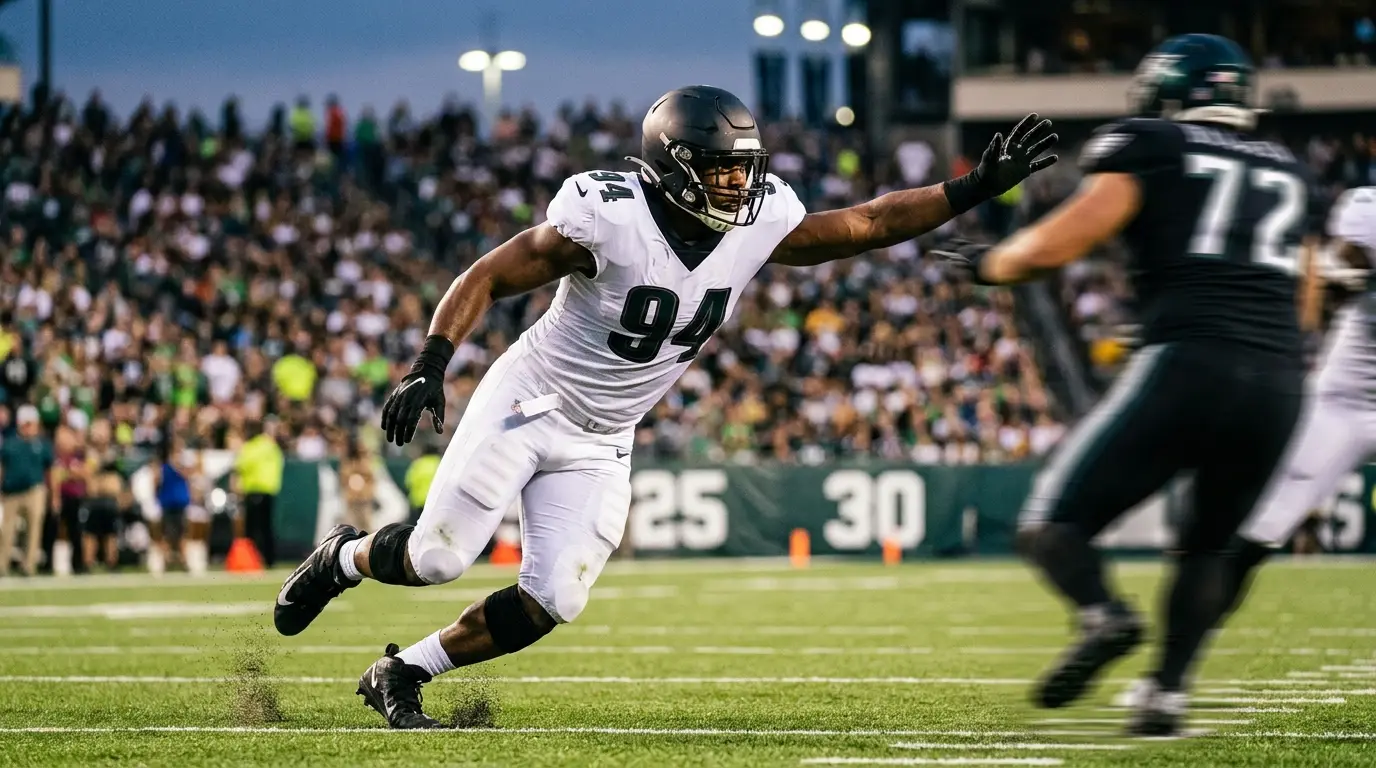
Edge rushers and defensive tackles have won the Defensive Rookie of the Year award in roughly two thirds of the last fifteen seasons. The position bias is not subtle. The remaining winners have come almost entirely from linebacker and cornerback, with safety winners being so rare that they barely register in the historical record. Defensive lineman is the modal winner profile by a wide margin.
The reason is structural rather than analytical. The voters who fill out the DROY ballot reward visible, statistically clean defensive production, and sacks are the cleanest single defensive statistic that translates directly onto a ballot. A pass rusher with double-digit sacks has an irresistible narrative profile for voters. A linebacker with 130 tackles requires the voter to engage with film and contextual analysis to assess value, which a portion of the voting pool simply does not do at sufficient depth.
The trader implication is that the DROY futures board should be read with sack potential as the dominant input. A rookie edge rusher entering a defensive scheme that generates pass-rush opportunities, with a clear path to starting snaps and no veteran edge rusher absorbing the snap share, is the textbook DROY candidate regardless of their absolute draft slot. Conversely, a rookie cornerback drafted in the first round but entering a scheme that does not produce interception opportunities should be priced longer than the headline draft position suggests.
The draft slot correlation that the market sometimes misreads
The aggregate data shows that DROY winners come disproportionately from the top of the first round, with the modal winner picked inside the top fifteen. The naive read of that data is that the futures market should automatically favour the highest-drafted defenders. The disciplined read is more nuanced.
The draft slot correlation is largely a function of opportunity rather than talent ceiling. Top-fifteen picks land in defensive schemes that need them to start immediately, which is the actual driver of the voting outcome. A defender drafted at pick 25 to a team with a settled defensive front will play fewer snaps and produce fewer ballot-relevant statistics than a defender drafted at pick 5 to a team rebuilding its front seven. The pick number is a proxy for snap share, not a direct talent signal.
This matters for pricing because the futures market sometimes prices a top-fifteen defender as if they were a DROY favourite when their landing-spot situation is actually unfavourable. A pass rusher drafted high but landing behind two productive veteran edge rushers will not start every snap, will not generate the pass-rush production, and will not win DROY. The futures price that ignores the situational fit is overvalued, and the contra position on a lower-drafted defender with cleaner snap-share access is undervalued.
Where UK pricing on DROY diverges from the headline awards
The DROY market is one of the thinnest of the major NFL futures markets on UK books. Sky Bet, which has reported a 77 per cent NFL volume increase since 2017, runs DROY pricing at margins typically 2 to 3 percentage points wider than MVP or Offensive Player of the Year. The Entain group’s 74 per cent Super Bowl volume growth from 2020 to 2024 has driven investment in headline pricing, but the niche awards including DROY remain less liquid and more inefficiently priced.
The practical consequence is that cross-book divergence on DROY is wider than on MVP. A rookie defender priced at 20-to-1 on one major UK book might be 28-to-1 on another, which represents a 40 per cent better return for the same underlying probability assessment. Line shopping on this market is more valuable than on any other major futures category on the UK boards, and the punter who systematically compares prices across three or four accounts before staking on DROY positions captures meaningfully more value than on the headline markets where the prices have converged.
The flip side is that DROY positions can be slower to settle and harder to cash out, which the related piece on no-vig probability calculation for NFL futures covers from the margin-stripping angle.
The four filters I run on every DROY candidate
My screening process on the DROY board has stabilised into four filters that I apply before staking any position. The first is the snap-share filter. Is the candidate projected to play at least 70 per cent of defensive snaps in their rookie year? Without that baseline, no defender can accumulate the statistical production required for a credible DROY case, regardless of talent ceiling.
The second is the scheme-fit filter. Does the defensive scheme this rookie is entering produce the statistical category their position is voted on? An edge rusher in a heavy-blitz scheme has materially better sack production prospects than an edge rusher in a coverage-heavy scheme. A cornerback in a man-coverage scheme has better interception opportunities than one in a Cover 2 zone scheme.
The third is the team-quality filter, applied as a moderator rather than a primary screen. The team does not need to be a contender for the rookie to win DROY, but the team’s defensive context matters. A defender on a team with a strong offence that gives the defence consistent third-down opportunities will accumulate more pass-rush production than a defender on a team that constantly chases the game and faces run-heavy game scripts.
The fourth is the injury-history filter, applied to the college tape. Rookies with notable college injury histories are typically priced too short by the futures market because the headline draft position dominates the pricing model. The contra-position is to fade rookies with significant college injury concerns even when their draft slot suggests otherwise, and to take longer-priced rookies with clean injury profiles whose snap-share access is comparable.
When the longshot DROY position actually pays
The DROY longshot that pays is almost never the cornerback drafted in the third round. The DROY longshot that pays is the edge rusher or pass-rushing linebacker drafted in the second round to a team with poor pass-rush production, where the rookie has a clear path to immediate starting snaps because the existing personnel is uncompetitive. That profile is consistently underpriced in the 30-to-1 to 60-to-1 range because the futures market keeps anchoring on draft slot.
I have hit this profile twice in the last five years. The pattern is reliable enough to build into a screening routine every July. The catch is that you need the snap-share information, which is typically only available after preseason joint practices and the first preseason game when the depth chart starts to clarify. Staking on the DROY longshot in May or June is guesswork because the snap-share picture is still hypothetical. Waiting until August, when the prices have moved but the snap-share signal is clearer, has consistently produced better outcomes than the early-summer rush to lock in opening prices.
The combination of position bias toward pass rushers, draft-slot correlation that hides situational variance, wider UK pricing margins than on headline awards, and the four-filter screening framework gives the disciplined punter a meaningful repeatable edge on this market. The casual punter who picks a flashy rookie name in May and stakes 25-to-1 on hope is fishing in the same pond, but with a worse rod.
A reliably inefficient market worth the homework
Defensive Rookie of the Year is the most position-biased futures market on the NFL board, the most draft-slot-correlated market once you account for snap-share access, and the market where UK cross-book pricing divergence remains widest. None of those facts is hidden. They are all visible in the historic data and in the live prices on the major UK books. The reason the market remains exploitable is that most punters never read the historic data carefully and never run the four-filter checklist before staking. The punter who does both walks into every August DROY board with a structural edge that no other futures market on the NFL calendar offers as cleanly.