The Tuesday morning after the Aaron Rodgers Achilles injury in September 2023, I had three different positions to triage before market open. A Super Bowl outright on the Jets at 12-to-1. A division-winner future on the Bills that I had taken in July partly on Jets-related logic. And an MVP position on a backup quarterback who was now suddenly relevant. Within forty minutes I had repositioned across all three. The triage discipline I used that morning is the same one I use every time a meaningful quarterback injury crosses the wires, and it is the discipline that separates futures punters who survive injury volatility from those who get destroyed by it.
This piece walks through how quarterback injuries cascade across futures markets, why the cascading effects are predictable enough to model, where the market consistently overreacts and underreacts, and the practical triage process every UK punter holding NFL futures positions should have ready when the news hits.
Quarterback Injury Impacts: Cascading Line Movements on Futures
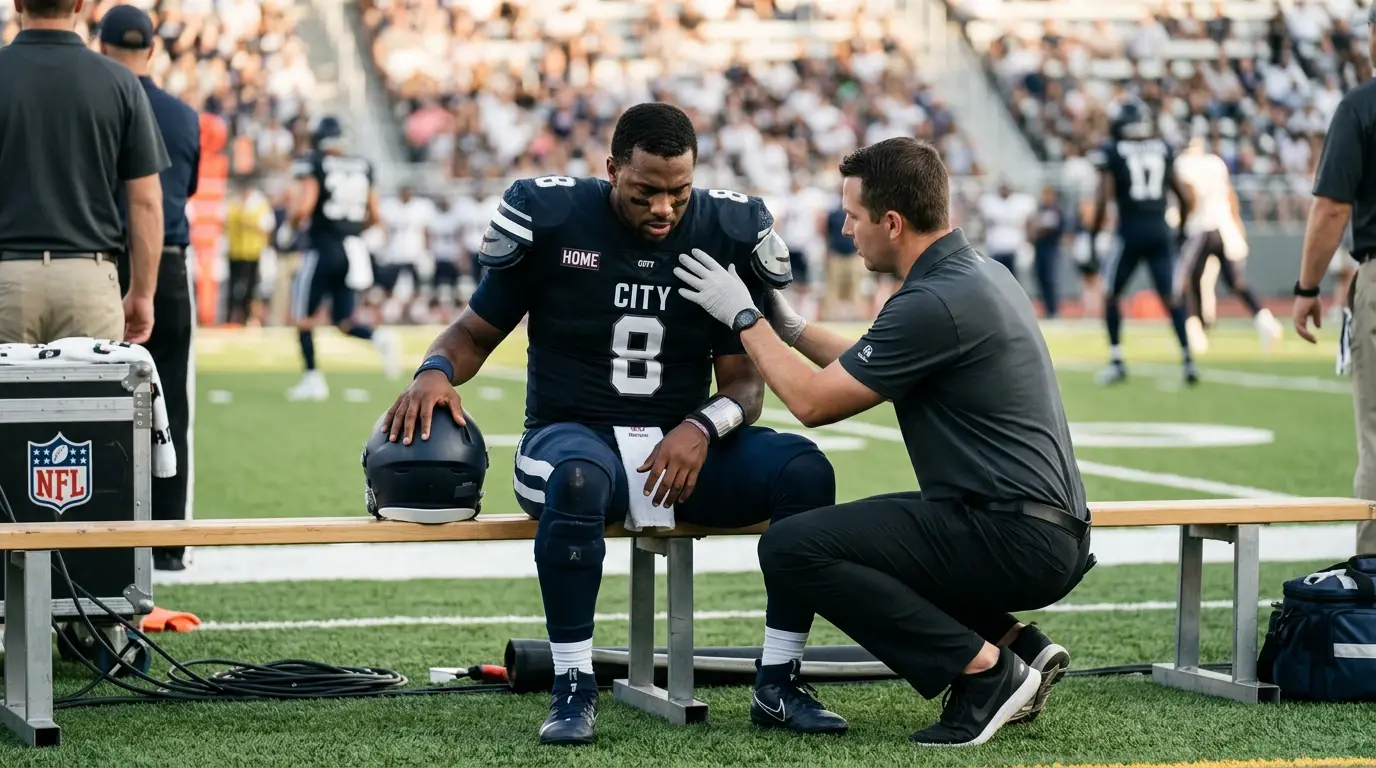
Quarterback is the only position on the NFL field whose absence reshapes multiple futures markets simultaneously. When a starting quarterback goes down for an extended period, the immediate price impacts ripple through the team’s Super Bowl outright, the team’s division future, the team’s win total, the MVP market if the quarterback was a candidate, the division rivals’ futures, and the conference outright. A serious quarterback injury can produce meaningful price moves on fifteen to twenty distinct futures markets within an hour.
The cascading pattern follows a predictable hierarchy. The injured player’s own team futures move first and most dramatically. Division rivals move second, typically within thirty minutes. Conference contenders move third, within two hours. Out-of-conference contenders that benefit indirectly through Super Bowl probability redistribution move fourth, sometimes not until the following day. The MVP market reprices immediately for the injured player and over the following 24 hours for the candidates who newly benefit from the redistribution of votes.
The trader implication is that the price discovery during the first hour after a quarterback injury announcement is incomplete, which creates a brief window where the secondary effects on division and conference markets have not yet fully priced. Punters who can execute trades within that window on the secondary markets capture value that disappears within two to three hours as the cascading reprice completes.
The injury severity tiers and their pricing impact
Not all quarterback injuries produce equal futures price impact. The tier hierarchy that emerges from the data has four distinct levels. The most severe tier covers season-ending injuries: ACL, Achilles, multi-week neurological absences, and surgical procedures requiring three or more months of recovery. These produce maximum cascading price impact and the team’s Super Bowl outright typically lengthens by 60 to 80 per cent within 24 hours.
The second tier covers multi-week absences in the four-to-eight-week range, typical of high-grade ankle sprains, broken non-throwing hand bones, and similar injuries. These produce 25 to 40 per cent lengthening on the team’s Super Bowl outright and require the punter to assess the timing question carefully. A four-week absence in September is different from a four-week absence in November.
The third tier covers short-term absences of one to three weeks, where the team’s win total takes a measurable hit but the Super Bowl outright is largely unaffected. The market sometimes overreacts to this tier in the first hour and then corrects within 24 hours, which creates a small but reliable contrarian opportunity for punters who can act quickly.
The fourth tier covers injury reports that produce uncertainty without confirming the absence. The cleanest example is the questionable-tag week before a game, where the player’s status is genuinely uncertain on Wednesday and not resolved until Friday or Saturday. The futures market typically does not move meaningfully on tier-four injuries, but the game-day moneyline and spread markets do, which can create indirect effects on hedging decisions on existing futures positions.
Where the cascading reprice consistently overreacts
The most consistent overreaction pattern on quarterback injuries is on the team’s MVP candidate teammates. When a starting quarterback is injured and an MVP candidate teammate, typically a skill-position player or a defensive player, is presumed to be affected, the market sometimes lengthens that teammate’s MVP price more than the actual statistical impact justifies.
The mechanism is that voters reward team success in MVP balloting and the injured quarterback’s team is now less likely to produce the win total required for serious MVP consideration. But the secondary effect overstates the team-success penalty in the early hours after the injury announcement. A defensive MVP candidate whose team’s offence collapses can still have a strong individual season; the team’s win total may decline but the defensive player’s statistical production often increases as the team plays more close games and the defence gets more high-leverage snaps. The market does not always price this counter-effect immediately, and the contrarian position on the defensive MVP candidate after a quarterback injury can pay.
The second consistent overreaction is on the injured player’s own team’s division-winner future. The market reads the injury as a confirmation that the team’s division-winning probability is dramatically reduced, which is often correct in the short term but sometimes overstates the impact when the team has strong defensive personnel and the division is weak. A division with multiple struggling teams can be won at 8-9 or 9-8, which is achievable even with a backup quarterback for several weeks. The contra-position on the post-injury division future can pay when the team’s defensive personnel and division strength support the case.
The longshot bias dynamics that drive some of these market reactions are covered in detail in my piece on longshot bias in NFL futures, which I would read alongside this one when thinking about how to position around quarterback injury news.
The backup quarterback factor
The futures price reaction to a starting quarterback injury depends heavily on the quality of the backup who will replace him. The market typically prices backup quarterback quality in two distinct categories: capable starter-level backups and clearly subordinate backups. The first category covers teams that have a backup with prior starting experience and reasonable career-average production. The second category covers teams whose backup has not started a meaningful NFL game or has demonstrably below-replacement-level production.
Teams with capable backup quarterbacks see their Super Bowl outright lengthen by significantly less after a starting quarterback injury than teams with subordinate backups. The price difference can be 30 percentage points or more between the two categories, depending on the timing and severity of the injury. The trader implication is that backup quarterback quality should be a known variable for every futures position the punter holds. Knowing the depth chart in advance allows for faster and cleaner triage when the injury announcement hits.
The 2017 Eagles Super Bowl run is the canonical example of the capable-backup pattern paying off, where Nick Foles took the team to a championship after Carson Wentz’s late-season ACL injury. The futures market sharply lengthened Philadelphia’s Super Bowl outright after the Wentz injury, and the punters who held the contra-position on the Eagles into the playoffs were rewarded with one of the most profitable single positions of the last decade.
The triage process every UK punter should have ready
The triage process I run when a meaningful quarterback injury announcement crosses the wires has five steps. Step one is to identify every futures position I currently hold that is affected. This means the team’s Super Bowl outright, the team’s division future, the team’s win total, the quarterback’s individual MVP position, and the division rivals’ positions.
Step two is to assess the injury severity tier using whatever medical reporting is available in the first hour. The reporting is often incomplete and the disciplined approach is to assume the higher severity tier when the reports are ambiguous, because the cost of underreacting to a serious injury is greater than the cost of overreacting to a moderate one.
Step three is to execute the immediate hedges or position closes on the affected positions, starting with the highest-conviction reprices and working outward. The first hour after the announcement is the window where cross-book pricing diverges most widely as different books react at different speeds, which means line shopping is unusually valuable during this trading window.
Step four is to identify the secondary opportunities on the markets that have not yet fully repriced. Division rivals, conference contenders, and MVP candidates from the injured player’s team are all candidates for new positions during the cascading reprice window. The disciplined approach is to take small initial stakes during the first two hours and to scale up only if the secondary repricing confirms the thesis over the following 24 hours.
Step five is to set monitoring triggers for the medical updates over the following week. The initial injury reports are often revised within 48 to 72 hours, sometimes upward in severity and sometimes downward. Positions taken in the immediate reprice window should be reviewed when the revised medical reporting becomes available, and the punter should be willing to reverse course if the revision changes the underlying probability assessment.
An expected event that demands prepared positioning
Quarterback injuries are the most predictable kind of unpredictable event on the NFL futures calendar. They happen every season, multiple times, to teams across the league. The futures market reacts in patterns that have been stable for at least a decade, the severity tiers are recognisable, and the cascading reprice across multiple markets is observable in real time. The UK punter who treats quarterback injury news as a triage exercise rather than a surprise has a significant repeatable edge over the punter who reads each injury as a shock event and reacts emotionally. The work is done in advance, the depth charts are mapped before the season starts, and the cascading triage is executed quickly when the news hits. That preparation is one of the highest-leverage habits available to anyone holding NFL futures positions through a full season.