
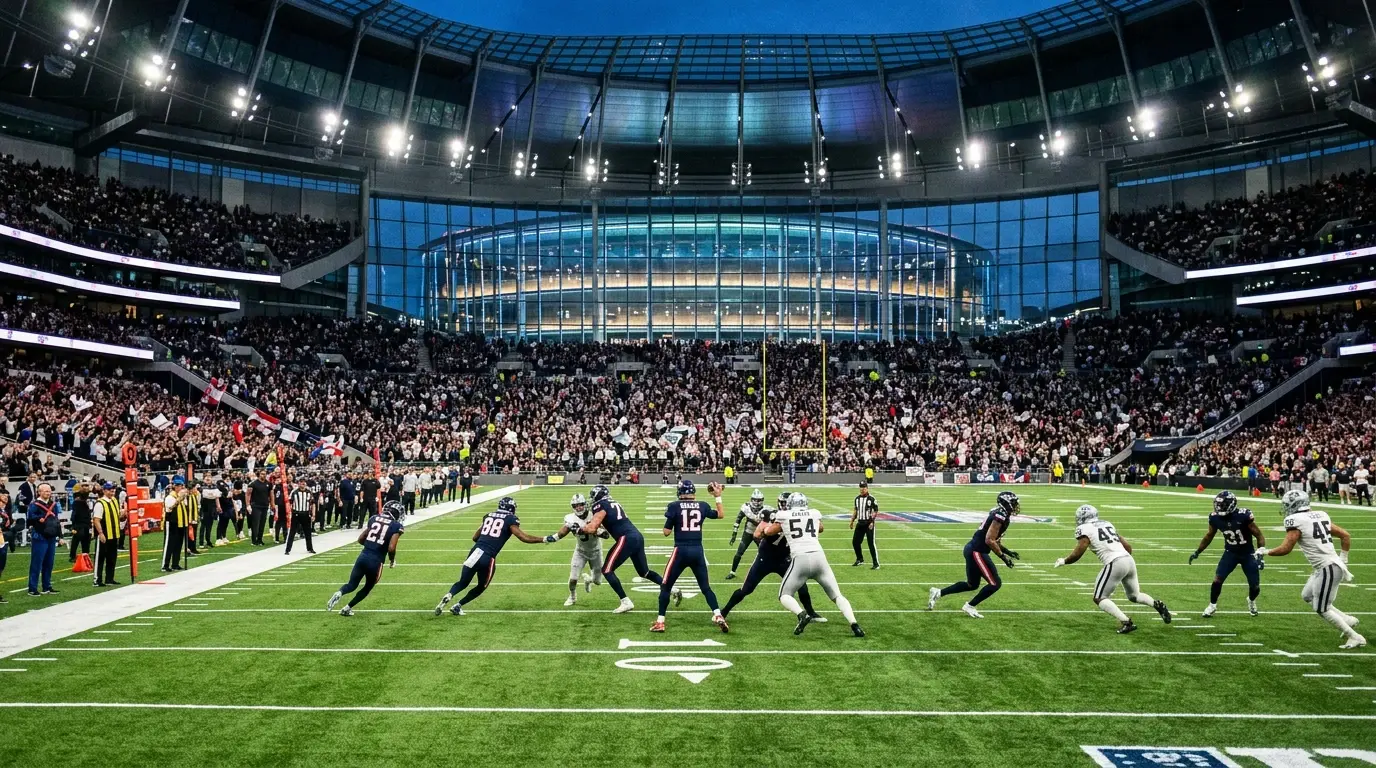
I was at Wembley for one of the Jaguars’ London games a few years ago and the thing that surprised me most was not the size of the crowd — it was how many of the people around me were watching the game with a stake on the outcome. Conversations about point spreads in cockney accents are a particular kind of cultural moment, and they hint at the deeper question this piece is going to answer: do NFL London games actually move UK futures markets, or do they just look like they should? The honest answer is yes, they move them, but in ways that most UK punters miss because the movement happens on adjacent markets rather than on the game line itself.
The 2025 NFL London game between the Rams and Jaguars drew 86,152 spectators to Wembley, a single-season record, and the year before saw 86,651 at the Jaguars-Patriots fixture. Those are not coincidences — they are signals of how deep the UK NFL audience has grown, and they have implications for how futures markets price the visiting and traveling teams.
History of NFL London Games and Betting Market Evolution
The NFL International Series began in 2007 with the Giants and Dolphins at Wembley, and the league has now generated more than £600 million in spectator spending across UK fixtures since that opening game. The series has expanded from a single annual game to three London fixtures per year, plus Dublin, Madrid and Berlin games in recent seasons. The 2025 international slate included seven regular-season games abroad — three in London, one each in Dublin, Berlin, Madrid and Sao Paulo, with the seventh elsewhere.
Roger Goodell’s framing of this growth is worth quoting because it sets the strategic context. He told a Good Morning Football interview that “now, you go over to London and you have a hard time telling whether you’re in London or whether you’re in the Meadowlands. The fans there are sophisticated; they understand the game, they appreciate the game.” That is not a marketing line. It is the commissioner acknowledging that the UK fanbase has matured to the point where the league treats London games as competitive events with real fan engagement, not as exhibition curiosities.
The UK pricing implications of this maturation are significant. When London games were exhibition-feeling fixtures, the futures market treated them as essentially neutral events that did not affect the participating teams’ season trajectories. Now that they are competitive games with full home-field implications for the designated home team, the result of a London game can meaningfully shift division and conference futures pricing on both participating teams. Chris Randall at William Hill captured the trader’s view bluntly when he told ESPN Chalk that “the NFL London games do attract more interest, but I’d say a decent part of this is the fact they’re generally on earlier in the day as a standalone event.”
The 2026 London fixtures and their futures relevance
The 2026 international slate includes nine games, with three in London: Eagles-Jaguars, Colts-Commanders, and Jaguars-Texans. That mix is interesting from a futures perspective because it includes two teams in the AFC South playing each other in London — Jaguars-Texans — which means the result will materially affect that division’s futures market. A Jaguars win in London essentially locks in significant divisional leverage early in the season; a Texans win does the opposite.
The Eagles-Jaguars matchup carries inter-conference implications. The Eagles enter most seasons as a top NFC contender, and their performance in London is a meaningful data point for their conference and Super Bowl futures prices. A loss to the Jaguars in a neutral-site game can ripple through their Super Bowl outright pricing for two or three weeks afterwards, partly because the loss itself counts in the record and partly because the market interprets neutral-site losses as evidence of vulnerability rather than as schedule noise.
The Colts-Commanders fixture is the most divisionally interesting one. Both teams are typically priced as second-tier division contenders entering the season, and a London result between them can shift the AFC South and NFC East futures markets in opposite directions. UK punters who stake division futures should circle the London weekend on their calendar and be prepared to act on the price moves that follow the result.
Crowd, jetlag and the neutral-site advantage
The conventional wisdom in trader circles is that the team designated as the “home” team in a London game gets less actual home-field benefit than they would in their domestic stadium, and the team designated as the “visitor” suffers less of a road disadvantage than they would in a normal road game. Both effects compress the typical home-field edge that the betting market assumes. The result is that London game lines tend to be tighter than the same matchup would be in either team’s home stadium.
The jetlag question is more nuanced. The home team in a London game — whichever side is designated home — has typically flown over earlier and has had more time to adjust to UK time zones. The visiting team in a Sunday London game has often flown over on Friday or Saturday and is playing at the equivalent of 6:30 in the morning Pacific time. That gap creates a genuine if subtle disadvantage for visiting West Coast teams in particular, and it is one of the few structural edges that UK punters can identify on the London game line itself.
The 6.2 million average audience for the 2025 NFL International Games on NFL Network — a record figure that grew 32 per cent year over year — reflects the underlying audience growth that drives all of these effects. More viewers means more action means more price sensitivity on the London markets, which means the structural edges become harder to extract over time as the markets mature.
How a London upset can reshape division futures
The single biggest futures-market effect of London games comes not from the game-line result itself but from the divisional ripple effects in the days afterwards. Take the historic example of a divisional underdog winning a London game over a divisional favourite. The favourite’s price on their own division market lengthens by 20 to 30 per cent in the following 48 hours. The underdog’s price shortens by a similar magnitude. The conference markets follow at smaller magnitudes — typically 5 to 10 per cent moves on both participants.
The Super Bowl outright markets show the smallest London-game effect, because championship probability is a 17-game story and a single neutral-site game rarely changes the championship probability assessment by more than a few percentage points. The exception is when a contender suffers a significant injury in a London game, in which case the Super Bowl price can move sharply and quickly, mirroring the price moves that follow major injuries at any other time in the season.
The trader Chris Randall’s observation that London games take “more than they deserve to take, based on the quality of the matchups” tells you something about UK public behaviour around these fixtures. Recreational punters stake heavily on London games partly because they are physically accessible — many UK fans have actually attended at least one London game — and that emotional connection translates into heavier-than-average pre-game action. The result is that public money on London game lines is denser than the typical NFL fixture, which makes the post-game futures moves on both participating teams more dramatic than the same teams’ moves would be after a non-London game. For punters thinking about the cumulative international growth picture, the related analysis in NFL UK TV coverage and futures betting covers the broader question of how UK audience growth feeds into betting volume.
Adding the London angle to your futures playbook
London games are not a market unto themselves for UK futures punters — they are inputs into the division, conference, and Super Bowl markets you are already tracking. Treat them that way. Circle the London weekend on your calendar. Watch the divisional and conference price moves in the 48 hours after each game. Be prepared to act on the inevitable overreactions, particularly on the division market of the team that loses an upset. And remember that London game lines themselves are typically tighter than the equivalent matchup would be in either team’s home stadium, which makes them better hedge windows than they are direct staking opportunities. The London games are part of the futures calendar now, not a curiosity outside of it.