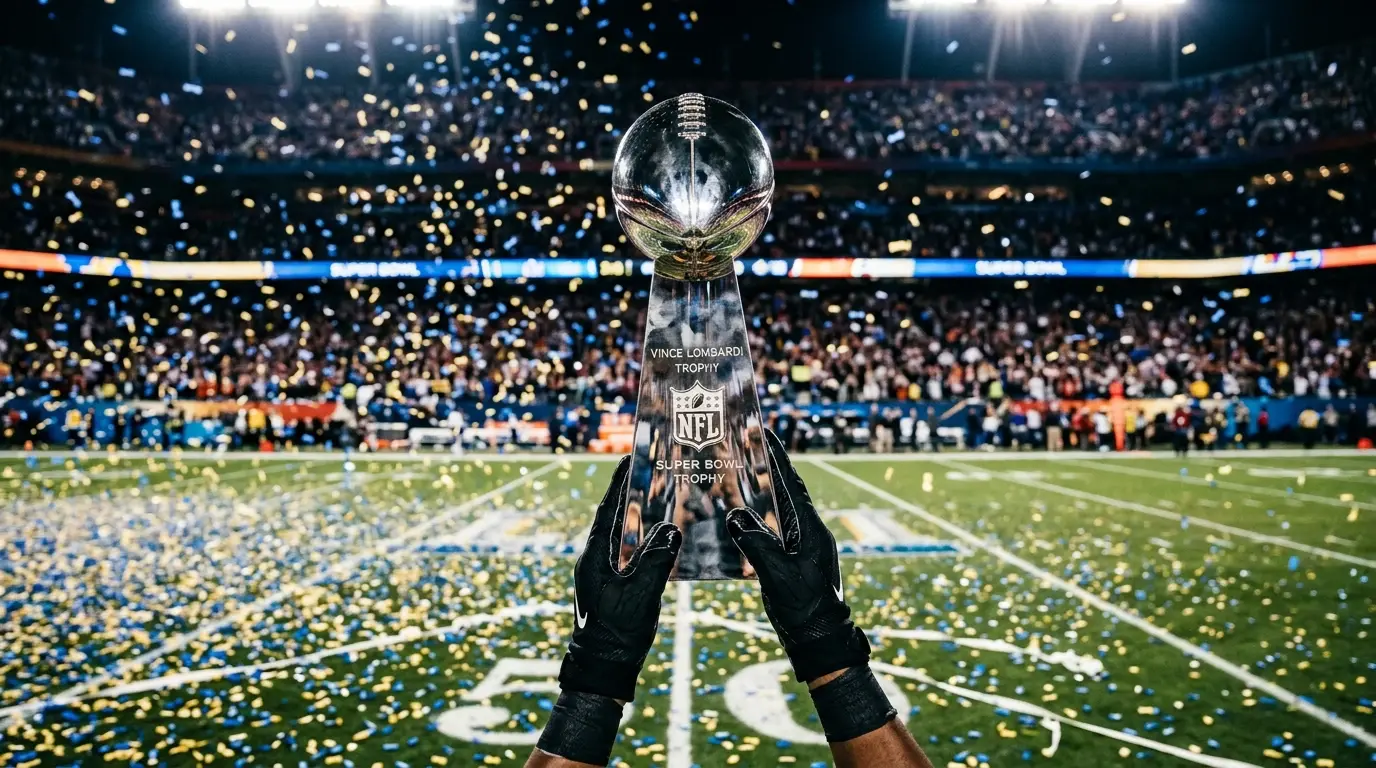
Nine years ago, when I first started pricing season-long American football markets for a UK trading desk, the Super Bowl outright was a curiosity tucked behind racing and Premier League. Today it pays my rent. The AGA pegged legal handle on Super Bowl LX at $1.76 billion, up roughly 27% on the prior year, and the UK side of that handle has been growing in lockstep — Super Bowl LVIII pulled 3.4 million British viewers, a 48% jump on 2023. That is the context in which every UK ante-post stake on the Lombardi Trophy now lives.
I want to walk you through how this market actually works from a punter’s bench, not from a press release. We will look at how outright stakes settle, where the current 2026 board sits, why the Rams once paid 150/1, how UK bookmakers have responded to the boom, and where I personally find structural value. Everything is in fractional and decimal — moneyline only when a US source forces my hand.
One housekeeping note before we begin. The Super Bowl outright is a single market with 32 possible winners. That seems simple. It is not. It is one of the most over-rounded boards a UK bookmaker offers, and the gap between a fair price and a sticker price is wider here than on almost anything else you will see across an NFL season. Understanding that gap is the whole game.
Before backing a heavy favorite, it is wise to review Super Bowl underdog history to see how often longshots cover the spread or win outright.
How a Super Bowl outright stake settles from kickoff in September to confetti in February
A friend of mine — a sharp Premier League trader who took up NFL in 2022 — once asked me, after staking £40 on the Bengals at 16/1 in late August, whether his slip “did anything” if Cincinnati lost in Week 1. The answer is the cleanest part of this whole market: nothing happens to it. Your bet sits in cold storage from September through to the first Sunday in February. Either Cincinnati lifts the Lombardi, or your stake is gone. There is no partial payout for a deep run, no consolation for losing in overtime, no settlement off conference finishing position.
That binary structure is what makes the Super Bowl outright feel different from almost every other UK ante-post market. Compare it with the Premier League title, where most punters can already read the table by November and a top-three side has months of meaningful results to react to. The NFL postseason is six rounds of single-elimination. One bad Sunday in mid-January and your stake is paper. That is why a 5/1 favourite on the Super Bowl board does not behave like a 5/1 favourite on horse-racing or football outrights — the variance is structurally higher.
Settlement itself is mechanically simple. The team you backed must be the last one standing after the final whistle in February. UK bookmakers settle on the result on the field; protests, post-game investigations and so on do not unwind a bet. If a team relocates, suspends operations or loses a franchise mid-season, individual bookmaker rules apply — most major UK operators void the stake and return funds, but the small print varies. I check this every time I open a 12-month position. You should too.
The bigger practical consideration is that your stake is locked. From the moment you click Place Bet to confetti time, the cash is unavailable. For a £100 punt that is no drama; for a £2,000 ante-post position taken in July, it matters, because that capital cannot work elsewhere for seven months. Hold percentage matters here too. A typical NFL game line carries hold around 4.55-4.8%; the Super Bowl outright often runs at 20%-plus across the 32-team field and nudges 30% deep into longshot territory. That difference is the price you pay to lock a season-long position — the bookmaker is taking the time risk too, and they charge for it.
One last settlement quirk that catches UK newcomers out. If you back the AFC or NFC representative to win the Super Bowl, that is the Super Bowl outright on your team — not a conference futures bet. The conference futures market is separate and settles when one of the championship games ends in January. You can hold both: an AFC champion ticket and a Super Bowl ticket on the same side. Their relationship is one of the more useful hedge mechanics in the season, and I will come back to it.
The Super Bowl 61 futures landscape
Christian Cipollini, the trading manager at BetMGM, said something earlier this year that should be taped to every futures punter’s monitor: “The Broncos, Bears, 49ers and Chiefs are our worst outcomes among legitimate contenders.” That is a US book talking, but the principle travels — bookmakers tell you, voluntarily, which teams they have over-exposed. The Super Bowl 61 board is built on those exposures.
Right now the picture at the top of the UK board looks like this. The defending champion Seattle Seahawks sit close to the front of the queue after their 4.5-point spread cover and outright win in Super Bowl LX. The Buffalo Bills, perennially short-priced and perennially the team that gets a sharp punter’s eye-roll, are still in the 8/1 to 10/1 region across UK accounts. The Philadelphia Eagles, who Cipollini publicly named as a preferred BetMGM outcome before LX, remain a top-three favourite. The Detroit Lions and Baltimore Ravens fill out the second tier. Behind them comes the broad middle: Chiefs, 49ers, Bengals, Cowboys, Texans — teams priced between 14/1 and 25/1 across most UK books.
Cipollini’s other recent quote tells you exactly what bookmakers fear before the next final. “In the biggest event of the year, bettors are pulling for the Seahawks while the book hopes for a low-scoring affair with minimal touchdowns. While there’s still some time before the game, it looks like the game and futures market will be rewarding to bettors if the Seahawks cover the game and win outright.” Translated: heavy public action on Seattle drove the price short, and the trading desk needs the favourite to fall over. That is useful context, because it tells you where the bookmaker’s pain point lives, and pain points are where shaded prices appear.
The middle of the 2026 board is where I spend most of my time. The Chargers, the Buccaneers, the Steelers — anything trading 33/1 to 50/1 with a credible postseason path. These are not the household names. They do not move on Sky Sports highlights packages. They are exactly the prices that get drifted to make room for short-priced public picks. When the Seahawks compress from 12/1 to 7/1 in the space of a month, the cash has to come out of somebody’s price, and it usually comes out of the third-tier contenders.
I also pay attention to what the long tail looks like. A clean Super Bowl 61 board at a UK bookmaker carries somewhere between 28 and 32 priced teams. Anything offered at 200/1 or longer is selling you a story, not a probability. If a team’s no-vig fair price would be 350/1, the bookmaker prices it at 200/1 and pockets the difference. That gap is the single biggest tax on retail punters in this market, and we will look at the maths in a moment.
Vegas favourites, Cinderella stories and the +15000 Rams
Twelve quid. That is what £12 returned £1,812 in 2000, after the St. Louis Rams won Super Bowl XXXIV at preseason odds of 150/1 in fractional terms — 151.0 in decimal, or +15000 if you must. Six members of staff at a small UK independent had a syndicate slip on the Rams that summer. They cleared £10,800 between them. I have met one of them. He still has the betting slip framed in his living room. He has not had another preseason longshot win in 25 years.
That is the central truth of the Super Bowl board. Favourites win. The OddsShark dataset shows that all-time, Super Bowl favourites have an outright record of 37-22, with 30-27-2 against the spread. The market is not stupid. It identifies the dominant team in roughly two-thirds of finals. What is less well known — and where the value lives — is the spread behaviour. Underdogs have covered the spread in 17 of the last 26 Super Bowls, including three of the last four. The mid-priced contender often loses by a touchdown after being tipped to lose by ten. That distinction between outright and ATS records is not academic; it shapes how I think about hedging.
Recent finals reinforce the point. Super Bowl LX itself was a win for the underdog at +4.5 — the Seahawks beat the spread and won outright at money line +188. Circa Sports took a $1.1 million wager on the Patriots money line in the run-up, the first seven-figure single ticket reported publicly on the game. The market priced one outcome; the result delivered another. That is the cycle every year. The favourite is identified correctly more often than not, but the price baked into the favourite leaves underdog tickets with positive expected value when the dog has any credible defensive identity.
What about deep longshots, the 100/1 and longer end of the board? The 1999 Rams remain the gold-standard story, but they are an outlier. Most preseason 100/1 shots end up wasting a stake. The structural reason is the longshot bias I will return to in the value section — UK punters love a long price, bookmakers price for that demand, and the implied probability on a 100/1 ticket is almost always shorter than the team’s actual chance of winning. Even when a longshot does deliver, it tends to be a team that opened at 40/1 or 50/1 and got shorter through the season, not a team that opened at three figures.
The 2007 Giants, who came in at around 50/1 preseason and beat the undefeated Patriots, are the modern blueprint for a “Cinderella that actually pays”. The 2017 Eagles, the 2020 Buccaneers behind Tom Brady, the 2022 Chiefs after a slow start — every recent longshot has shared one common feature: they had a credible quarterback by the time the playoffs arrived. That QB filter is the simplest piece of preseason discipline I can give a UK punter scanning the bottom half of the board. If you cannot name a credible postseason quarterback for the team, the price is not value. It is decoration.
UK appetite for Super Bowl wagering since 2020
The UK Super Bowl now is a different commercial animal to the one I was trading in 2017. Sky Bet alone reports a 77% rise in NFL handle from 2017 through 2022. Entain — owner of Ladbrokes and Coral — has been even more public about the numbers. Super Bowl 58 produced a 74% increase in stakes versus 2020 across Ladbrokes and Coral, and overall Entain UK NFL volume rose 11-12% year-on-year in 2024. These are not press-release numbers stripped of context. They mirror what trading desks see in their dashboards every Super Bowl Sunday.
What strikes me most is the demographic shift. The number of women in the UK betting on the Super Bowl grew by 217% over the four years from 2020 to 2024 across Entain UK brands. That is not a marginal trend. That is a structural change in who the futures customer is. The bookmaker product, the ad creative, the affiliate content — everything is being rebuilt around a much broader audience than the male-skewed pub-betting demographic of 2018. If you write about this market without acknowledging that, you are pricing for a customer who has already left the building.
Sameer Deen, Entain’s Chief Commercial Officer, put it cleanly when asked about the Super Bowl 58 surge: “It was an opportunity for us to innovate our sportsbook offer, enabling us to provide our UK and European customers with a truly global betting experience for the Big Game.” Translation: the trading desks now price the Super Bowl as a major event in its own right, with bespoke books, dedicated content and price-boost campaigns. Five years ago it was a footnote between the FA Cup fourth round and the Six Nations. Today it is a tentpole.
Look at where the money sits. Sky Bet’s published figures show that a typical NFL game attracts around nine times the handle of an NBA game and seventy times the handle of an MLB or NHL match. Chris Randall, head of US sports at William Hill UK, told ESPN Chalk that “the NFL London games do attract more betting interest” and added — in a line every UK NFL trader has memorised — “they certainly take more than they deserve to take, based on the quality of the matchups”. That is the real lesson. Volume in the UK is no longer correlated with the prestige of the fixture. It is correlated with broadcast windows, narrative and the simple fact that more Britons watch the NFL than ever before.
The Sky Sports three-year extension agreed in 2025 increases the number of live games shown by nearly 50% and includes every London and European fixture. That visibility translates directly into futures volume. A team playing in front of 86,152 Britons at Wembley in late October is a team UK punters back into deep postseason markets — sometimes correctly, sometimes wrongly, but always in size. The growth is real, the volume is real, and the pricing has shifted to reflect it.
How bookmakers price 32 teams and why the board never sums to 100%
Sit down with a printout of the current Super Bowl board and a calculator. Convert every fractional price into implied probability. Sum the column. You will get a number somewhere between 120% and 150%. The first time I did this with a friend who had punted ante-post for years on horses, he checked the maths three times. The probabilities cannot sum to more than 100% in a closed event. So why does the board?
Welcome to overround. Hold. Vig. Margin. Four words for the same number — the bookmaker’s edge, baked into every price. On a single NFL game, the hold typically runs at 4.55-4.8%. On the Super Bowl outright, it runs 20% or more — and on the long tail of 100/1+ teams it can push toward 30-40%. That is not the bookmaker being greedy. That is the price of providing a market that lasts seven months on outcomes that are deeply uncertain and that nobody can replicate on a betting exchange with the same liquidity.
Walk through a stripped-down example. Imagine a four-team board where everyone has a 25% true chance of winning. The fair price on each is 3/1 (decimal 4.0). A bookmaker prices each at 5/2 (decimal 3.5). Implied probability on each ticket is 28.57%. Sum the four: 114.28%. That is a 14.28% hold on a clean, equal-probability board. Now extend the same logic to 32 teams of wildly different strengths, with deep variance on the longshots, and you get the messy 120-150% boards UK punters face on the Lombardi.
Where this matters in practice: you can be right about which team is most likely to win the Super Bowl, back them at the bookmaker’s price, and still lose money over time. The 8/1 price might be a fair 7/1. The 28.6% implied probability on 5/2 might be a fair 25%. Without a no-vig calculation, you are flying blind on whether you are getting paid enough for the risk. That is why the futures hold problem deserves its own page on this site — and why every serious UK ante-post punter learns to devig before placing a stake.
One more practical note. Hold is not evenly distributed across the board. Bookmakers tend to price favourites with relatively thin margin (5/1 favourites might carry 8-10% hold, sometimes less if they are competing hard for market share) and price longshots with brutal margin (a “true” 200/1 team might be priced 75/1, an enormous shortening). That asymmetry means line-shopping for favourites between UK accounts can yield small fractional improvements; line-shopping the long tail can yield genuinely huge ones. The 50/1 at one book might be 80/1 at another for the same team in the same week. It pays to look.
When to back a Super Bowl outright — opening lines vs midseason vs playoff entry
The hardest question in this market is not which team to back. It is when. I have watched too many UK punters back the correct team at the wrong week and either pay 30% too much in held margin or miss the value entirely because they waited for confirmation that never came.
There are four sensible entry windows on the Super Bowl outright across a typical season. The first is the immediate post-Super Bowl drop in late February, when bookmakers publish next-season boards within 48-72 hours of the final whistle. These prices are at their fattest because nobody yet knows free agency outcomes, draft results or coaching changes. The trade-off is obvious — you are taking maximum risk on an unknown roster, and your capital is locked for the longest possible stretch.
The second window is the post-draft period in late April through May. The board has now absorbed the most important roster events of the off-season. Quarterbacks have changed jersey, rookies have been allocated and the truly broken teams have shed talent. Prices have begun to harden on the favourites, but contenders one rung below remain at attractive numbers. This is where I do the bulk of my preseason work.
The third window is mid-August through Week 1, after preseason action gives you the first signs of injuries and depth. Prices on the top tier compress noticeably here — a team I priced 10/1 in May might trade 7/1 by late August because the public has spent four months on hot takes. The compensating opportunity is the middle tier: teams that quietly looked sharp in preseason but have not been pumped by the betting public yet. The gap between favourites and middle-tier teams is at its widest in this window.
The fourth window is mid-November through early January, when seeding becomes clearer and the bookmaker’s risk position visibly shifts. Prices on division leaders compress hard; prices on wild-card contenders sometimes stay generous because the public reads “second place” as “not winning”. A 9-3 team facing a 12-1 division leader is often still the better Super Bowl bet, and bookmakers know this and don’t price it generously — but the gap is sometimes there, especially on teams that have been ignored by mainstream media.
Roger Goodell himself addressed the season structure question recently in a way that matters for timing decisions. “I’ve said many times 16 games, so that every team is playing a regular season game every season. I think that’s an important mark for us to go for. I think we’re well on our way.” For futures punters, the takeaway is that any further schedule expansion will reset win-total benchmarks and indirectly shift Super Bowl pricing. The mistake I see most often is staking in early February on the team that just lost — their roster, coaching staff and confidence are all in worse shape than they will be in May, but they get an emotional bid from punters who watched them go deep. Wait. The price will not improve, but the information will, and the information matters more than the price.
Three structural value spots on the Super Bowl board
Aron Wattleworth at bet365 said something after Super Bowl LIX that has stuck with me. “A Philadelphia victory was our preferred result for the Super Bowl Winner. For the Super Bowl this year, we experienced a good result pre-game, in play, and overall between our Futures position on Kansas City and overall heavier action that backed the Chiefs for the Super Bowl main game lines betting.” That comment is gold. It tells you that the bookmaker’s preferred outcome and the public’s preferred outcome are almost always different — and value lives in the gap.
Three places on the board reward UK punters consistently. The first is what I call the “second-tier favourite without the narrative”. When the Bills and Chiefs are priced 7/1 to 8/1 and the public is piling onto both because they are on Sky Sports every other week, a team like the Lions or Eagles at 9/1 to 10/1 often carries better expected value. The roster is comparable, the postseason path is comparable, but the price reflects which team got the most prime UK TV windows rather than which team is most likely to win. I size up here a lot.
The second is the “post-Week-3 dropping contender”. Most Super Bowl winners do not have a clean September. The 2017 Eagles, 2020 Buccaneers, 2022 Chiefs and 2023 Chiefs all looked vulnerable in the opening weeks before resetting. Bookmakers respond to those wobbles by lengthening the price; the public, watching highlights, treats the wobble as a signal. The result is a price that pays a fair-to-generous return on a team that has not actually changed fundamentally. I add to positions in mid-to-late September almost every year, on at least one team that lost a game I expected them to win.
The third is the “AFC vs NFC mismatch”, which is a structural arbitrage that opens about once every two or three years. When one conference is visibly stronger than the other, the conference winner futures market sometimes prices the weaker conference’s contender at decent value because their path to Super Bowl is short and the trophy game itself is now binary against the dominant AFC side. Backing both the AFC outright winner and the NFC outright winner can occasionally produce a no-lose Super Bowl exposure — usually not, but worth checking each year.
A fourth spot, flagged as advanced, is correlated hedging. If you hold a Super Bowl outright on Team A and Team A reaches the conference championship, the live exchange price on their opponent often offers a hedge that locks in profit without surrendering all of the upside. A long-dated position becomes a hedgeable position as the season narrows.
For UK punters with a structured staking plan, my view is that 60-70% of futures capital should sit on second-tier favourites taken in the April-to-August window. Maybe 20% on the third-tier value plays at 25/1 to 50/1. Maybe 10% on longshots, if you must — but with the explicit understanding that the longshot bias on this market is significant and the implied probability is rarely your friend. The clearest test of this is the historical record of 100/1+ winners on the board, which I unpack at length in my breakdown of 26 years of Super Bowl underdog data. Reading that before you stake a longshot will save you money.
Super Bowl futures FAQ
Bringing the Lombardi outright into a UK bankroll plan
Nine years in this market has taught me one thing above all: the Super Bowl outright rewards patience and punishes urgency. A £100 stake placed on the right team in May, sized to fit a sensible bankroll, will outperform ten £100 stakes placed on hot takes through the year. The maths is brutal in both directions — the favourite hits roughly two-thirds of the time, but the longshot bias on the rest of the board means most of your speculative tickets are paying you 60-70% of fair value.
The UK side of this market is the most exciting part for me as someone who has watched it grow from a curio into a tentpole. We now have Sky Sports broadcasting nearly every meaningful Sunday window, Wembley and Tottenham hosting record-breaking attendances, 14.3 million British fans of the sport and a genuinely diverse betting demographic across age and gender. The next decade looks structurally bigger than the last. Goodell hinted at a Super Bowl outside an NFL host city in his 2025 London comments, and a London final would change the entire UK ante-post landscape overnight.
What I would ask of you, if you take only one thing from this page: treat the Super Bowl outright as a position, not a punt. Size it like an investment, time it like a trade, hedge it like a trader. The bookmaker has 30% hold baked in across the full board and 15-20% baked in at the top. You cannot pretend that does not exist. You can either pay it without thinking, or you can do the maths and stake only when the post-vig price genuinely justifies the seven-month capital tie-up. The disciplined approach is the only one that pays.
Always ensure you are getting the best prices by consulting our top-rated NFL futures betting platform.